Insights
Table of contents
Selling a Business in Nova Scotia: What Owners Should Know
Published: March 22 2026
Table of contents
Nova Scotia has a distinct business landscape, a specific regulatory environment, and a buyer market that differs in important ways from what you'd find in Toronto or Vancouver. For a business owner in Dartmouth, New Glasgow, Antigonish, or Yarmouth who is considering a sale, understanding the provincial context is not peripheral detail — it is relevant to your valuation, your timeline, and the choices you make throughout the process.
This article covers the provincial factors that matter most to Nova Scotia business owners preparing for a sale: the industries driving M&A activity, the legal and regulatory considerations specific to the province, the buyer pool as it actually exists, and what distinguishes selling a business in Halifax from selling one in a smaller community.
The Nova Scotia Business Landscape
Nova Scotia's economy is one of the most diversified in Atlantic Canada, anchored by a combination of legacy industries and growing sectors that together produce genuine M&A activity across multiple verticals.
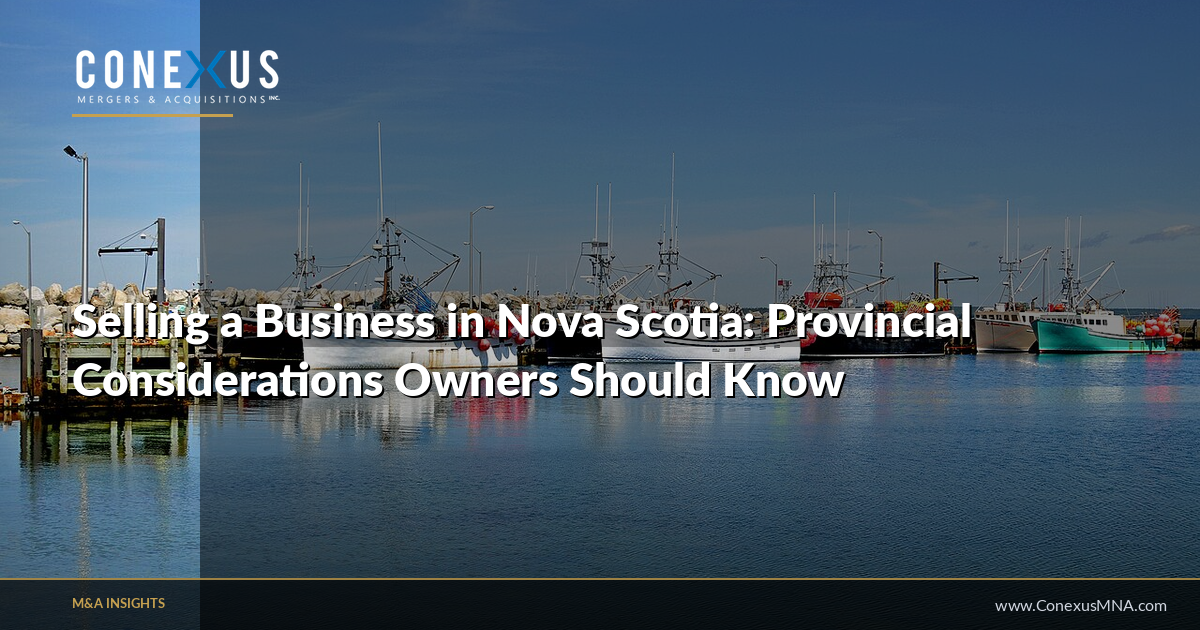
Ocean industries and seafood processing are central to the Nova Scotia economy and generate significant M&A activity. The seafood sector — lobster processing, finfish, aquaculture, and related supply chain and logistics businesses — has attracted both national and international buyers over the past decade. Consolidation pressure from global seafood companies, combined with succession challenges among family-owned processors, has produced an active transaction market. The strategic value of Nova Scotia seafood businesses to buyers in Japan, Europe, and the United States adds an international buyer dimension that is less common in other sectors.
Manufacturing spans a range of sectors in Nova Scotia: metal fabrication, building products, food manufacturing, and industrial equipment. The province's manufacturing workforce is experienced and, while facing the demographic pressures affecting the rest of Atlantic Canada, remains a meaningful competitive advantage for manufacturers who have invested in retaining and developing their people.
Construction, trades, and infrastructure businesses have seen growing buyer interest as infrastructure investment has increased across the province. Specialty contractors, equipment rental operations, and civil construction companies with established customer relationships and equipment assets are attractive acquisition targets.
Transportation and logistics businesses — particularly those with established route networks and long-term contract relationships — are an active sector in Atlantic Canadian M&A more broadly, with Nova Scotia participants benefiting from the province's role as a distribution hub for the region.
Healthcare and seniors services — including home care, physiotherapy, and private care facilities — have been among the most actively transacting sectors in Nova Scotia, driven by demographic demand and consolidation by national operators. While Conexus focuses on the physical and industrial business sectors, this context is relevant for business owners who interact with the broader transaction market.
Provincial Regulatory and Legal Considerations
NS Registry of Joint Stock Companies. Corporate records for Nova Scotia companies are maintained with the Registry of Joint Stock Companies. In a share sale, the buyer's legal team will conduct a corporate search to verify the corporation's standing, confirm the share register, and identify any registered encumbrances on the shares. Ensuring your corporate records are current — that annual returns have been filed, that the share register is accurate, and that director and officer information is up to date — is a pre-sale housekeeping item that avoids delays during due diligence.
Provincial tax considerations. Nova Scotia's combined federal-provincial corporate income tax rate is among the higher rates in Atlantic Canada, and the personal marginal income tax rate (approximately 54% at the top) creates a meaningful incentive for transaction structuring that reduces personal taxable income on sale proceeds. The arguments for share sales over asset sales, for holdco structures, and for LCGE utilization are particularly compelling in Nova Scotia's tax environment. Early engagement with transaction-experienced tax counsel is worth the investment.
Industry-specific licensing and permits. Certain Nova Scotia industries require provincial licenses or permits that do not automatically transfer to a new owner on a change of ownership. Food processing facilities require provincial or federal inspection registration. Liquor sales, hazardous materials handling, environmental permits, and professional service licenses all have their own transfer requirements. Your advisor and lawyer should inventory the licenses and permits the business holds, confirm their transferability, and identify any that require advance notice to or consent from provincial authorities.
Employment Standards Act and long-service employee risk. Nova Scotia's Employment Standards Act governs termination notice, severance, and workplace standards. In a business sale structured as a share sale, employment relationships generally continue without interruption — but this creates a specific risk that share buyers in Nova Scotia must understand. Long-tenured employees (those with 10, 15, 20+ years of service) carry significant common-law severance entitlements that transfer with the shares. A buyer who acquires shares is acquiring those obligations. If the new owner subsequently restructures and needs to terminate long-service employees, the severance exposure can be substantial — in some cases exceeding one month of compensation per year of service at common law. This is a due diligence item sophisticated buyers will examine closely in any Nova Scotia share sale. Sellers should be prepared to disclose the tenure profile of their workforce and, in some cases, to negotiate indemnities or price adjustments that reflect this exposure. In an asset sale, employees may have rights to treat the change as a constructive dismissal and claim severance — a different but related concern. Understanding the employment law implications of your deal structure, with Nova Scotia-specific legal counsel, is essential preparation.
The Nova Scotia Buyer Pool
The buyer pool for Nova Scotia businesses operates on several levels, each with different characteristics:
Local and regional buyers are the most natural acquirers for many Nova Scotia businesses. Competitors in the same sector, adjacent businesses looking to expand capabilities or market share, and local operators with capital to deploy represent the foundation of the buyer market. For businesses below the $5 million enterprise value range, regional buyers will typically form the core of any serious acquisition process.
National buyers — consolidators, PE-backed platforms, and strategic acquirers from Ontario and Quebec — are increasingly active in Nova Scotia's stronger sectors. Food processing and seafood, industrial manufacturing, and specialty construction trades have all seen national buyer interest. Working with an advisor who has national buyer relationships — and who can credibly represent a Nova Scotia business to buyers in Toronto, Montreal, or Vancouver — expands the buyer pool significantly.
ACOA and provincial programs supporting business transitions. The Atlantic Canada Opportunities Agency provides programs that support business development and growth, some of which can be relevant to buyers of Nova Scotia businesses — particularly acquirers making investments that will sustain employment and expand operations. The province's own programs include Business Development Nova Scotia and sector-specific incentives. Understanding these programs doesn't directly increase your sale price, but it expands the profile of buyers who can afford to pay a reasonable price and who have an incentive to maintain the business in Nova Scotia.
Halifax vs. rural Nova Scotia. The transaction market in the Halifax Regional Municipality operates differently from the rural Nova Scotia market. Halifax businesses benefit from a larger local buyer pool, better access to professional advisory services, and more national buyer attention. Rural Nova Scotia businesses — in Cape Breton, the Valley, the South Shore, and the Northern Highlands — face a more constrained local buyer pool and require more deliberate outreach to regional and national buyers to create competitive tension in a sale process. This is not a reason to accept lower prices; it's a reason to invest in an advisory process that reaches beyond the immediate geographic market.
What It Means to Sell Well in Nova Scotia
Selling well in Nova Scotia requires the same fundamentals that apply anywhere — a well-prepared business, clean financials, documented processes, a strong management team, and a structured sale process managed by experienced advisors — combined with an honest understanding of the regional market and access to the buyer pool that goes beyond the obvious local candidates.
The businesses that achieve the best outcomes in Nova Scotia M&A are those whose sellers have invested time in preparation, who have engaged advisors with genuine relationships in the buyer community, and who approach the transaction with realistic expectations about regional pricing while positioning their businesses aggressively to the national buyer pool that can pay premium prices when the right fit is there.
Ready to understand what a Nova Scotia business sale would look like for you? Book a confidential consultation with Conexus M&A. We're headquartered in Atlantic Canada and specialize in the Nova Scotia market — the regulatory environment, the sector dynamics, and the buyer relationships that produce the best outcomes for Nova Scotia business owners.