Insights
Table of contents
The Changing Landscape for Marine & Fishing Business Owners in Atlantic Canada
Published: March 23 2026
Table of contents
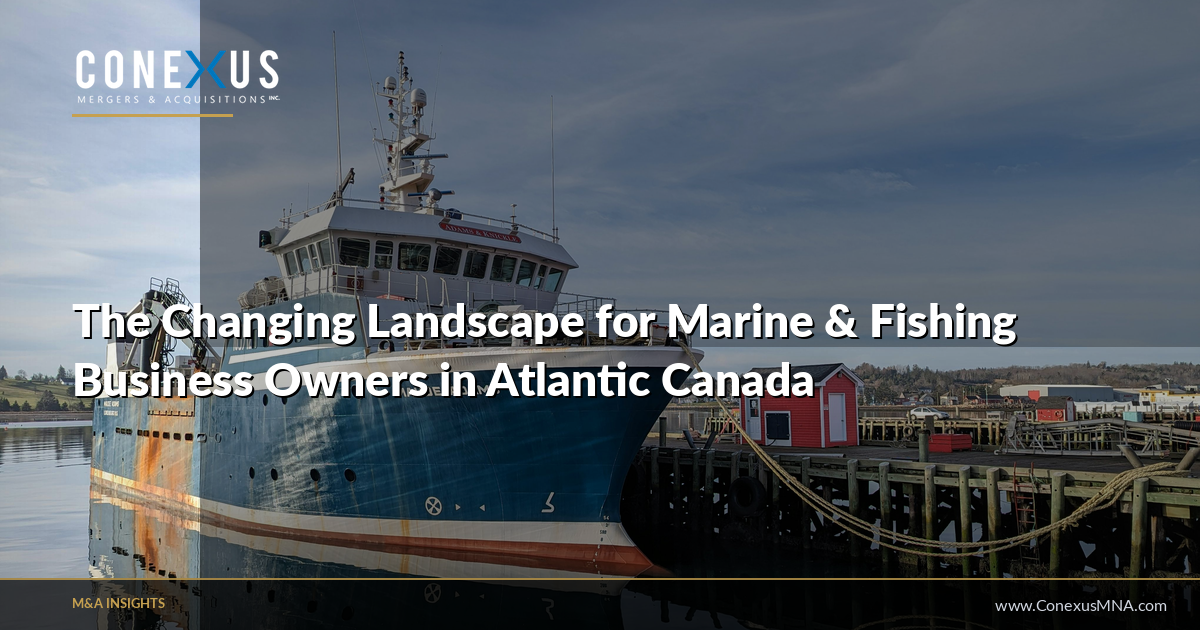
No sector in Atlantic Canada is more closely woven into the identity of its communities — or more complex to navigate in an ownership transition — than commercial fishing and marine industry.
The fishing businesses of Nova Scotia, New Brunswick, Prince Edward Island, and Newfoundland and Labrador represent not just economic assets but generational legacies: licenses earned over decades, vessels maintained through salt and weather, processing relationships built through a combination of quota access, catch quality, and the trust that develops between a fishing operation and its buyers over years of reliable delivery.
That complexity is now intersecting with a set of forces that are reshaping ownership across the entire sector. License values have reached historic highs. Corporate consolidation — by processors, by aquaculture operators, by vertically integrated seafood companies — is changing the competitive landscape. The generational question of whether the next generation will fish is being answered, family by family, in ways that are often painful and almost always consequential.
And the M&A dynamics in commercial fishing and marine industry are genuinely unlike those in any other sector — a specialized domain where the wrong advisor can cost an owner hundreds of thousands of dollars in a transaction where the stakes are already high.
DFO License Values at Historic Highs — and What That Means for Owners
Fisheries and Oceans Canada (DFO) licenses represent the foundational asset of any commercial fishing operation. Access to quota — the right to harvest specific species in specific quantities from specific zones — has been managed under an increasingly restrictive framework for decades, and that restriction has produced a powerful economic dynamic: as the total allowable catch has been maintained or reduced to protect stock sustainability, the value of the licenses that represent access to that harvest has appreciated substantially.
The appreciation has not been uniform across all species, but the trend across high-value Atlantic Canadian fisheries has been consistent:
- Lobster — Licenses on the southwest Nova Scotia coast (LFAs 33, 34, and 35) have appreciated dramatically over the past fifteen years, driven by strong global demand and relatively stable TAC. Southwest Nova Scotia lobster licenses are among the most commercially valuable fishing licenses in the world.
- Snow crab — Gulf of St. Lawrence and Newfoundland crab quota has followed a similar trajectory. Quota values have increased substantially, though with more volatility tied to stock assessments and annual TAC decisions.
- Groundfish — After years of retrenchment following the cod moratorium, groundfish licenses have stabilized and in some cases appreciated as stock recovery has allowed cautious TAC increases.
- Halibut, shrimp, and scallop — High-value species licenses in these categories have seen significant valuation increases driven by the same fundamental scarcity dynamic that affects all restricted-access fisheries.
For many fishing families across Atlantic Canada, the DFO licenses they hold represent the majority of their net worth — often a multiple of anything else they own. These individuals hold assets whose value has increased faster than almost any other category of investment available to Atlantic Canadians, and many of them have not had a current, professionally conducted valuation of what those assets are actually worth today.
The implication for ownership transition is direct and urgent. Industry conversations about what licenses are worth tend to lag reality, to reflect transactions that happened years ago, and to systematically understate what a properly structured sale process with the right buyers would produce. An owner who sells based on informal industry price estimates rather than a current professional valuation is almost certainly leaving money on the table.
Corporate Consolidation Is Reshaping the Sector
The commercial fishing sector in Atlantic Canada has experienced significant corporate consolidation over the past two decades, and that consolidation is continuing. Understanding the major players and their acquisition strategies is directly relevant to any fishing business owner considering their options.
Clearwater Seafoods — now owned by a coalition of First Nations groups and Premium Brands Holdings following its landmark 2021 acquisition — built one of the world's most recognized seafood brands on the foundation of Atlantic Canadian shellfish quota. Clearwater's trajectory demonstrates the value that can be created by combining license access with processing capability, brand development, and global distribution — and the premium that a well-positioned acquirer will pay for access to quality license portfolios in Atlantic Canada.
Cooke Aquaculture, headquartered in Blacks Harbour, New Brunswick, has grown from a regional salmon aquaculture operation into one of the world's largest aquaculture companies, with operations across North America, Europe, South America, and Australia. Cooke's appetite for strategic acquisitions in Atlantic Canada — both aquaculture sites and processing assets — reflects a vertically integrated growth strategy that has consistently paid competitive prices for well-positioned assets.
Premium Brands Holdings, a Vancouver-based specialty food company, has been one of the most active acquirers in Atlantic Canadian seafood and food processing, assembling a portfolio that includes lobster processing, value-added seafood production, and significant distribution infrastructure. Their acquisition activity demonstrates the appetite that national food companies have for Atlantic Canadian seafood assets — and the premium they will pay to secure them.
Beyond these anchor companies, a range of regional processors, vertically integrated fishing enterprises, and financial buyers have been active in Atlantic Canadian marine M&A. The sector is not without sophisticated buyers — but those buyers have access to information and advisors that most individual fishing license holders do not. This information asymmetry works against sellers who approach a transaction without professional advisory support.
The Generational Question: Will the Children Fish?
For fishing families across Atlantic Canada, the succession question is existential in a way that is different from most other business sectors. Fishing isn't just a business — it is a way of life, a community identity, and in many cases the foundational economic activity of the communities where fishing families have lived for generations. The decision about whether the next generation will continue is not simply a business decision; it involves questions of identity, obligation, family relationships, and community belonging that make it harder to approach rationally than a pure financial analysis would suggest.
And yet the reality is that second-generation succession in commercial fishing is declining. Several forces are driving this:
- The children of fishing families have more educational and career options than their parents did
- The physical demands of the work have not diminished, while onshore career opportunities have grown substantially
- Regulatory complexity has grown considerably over the past two decades, adding operational and administrative burden
- The capital intensity of maintaining a competitive fishing operation has increased significantly
- Weather and stock volatility create income uncertainty that educated young people can avoid by choosing other careers
The fishing family where the owner is in their early sixties and no child has expressed genuine, committed interest in continuing the operation is facing a transition decision that cannot be deferred indefinitely. The license doesn't retire when the owner does. The vessel requires maintenance whether it's fishing or sitting in the harbour. And the window for a properly planned sale — one that captures the full value of what took decades to build — is narrower than most owners acknowledge.
Families facing this decision benefit from separating the emotional from the financial as much as possible, and from getting professional, confidential advice early enough to have real options. The owner who acknowledges that external sale is likely and begins preparing two years in advance will have choices that the owner who waits until health or fatigue forces the issue simply will not.
Aquaculture Growth vs. Tightening Wild Harvest Quotas
Two parallel dynamics are reshaping the supply side of Atlantic Canadian seafood simultaneously — and both have M&A implications for owners in the sector.
| Aquaculture | Wild Harvest | |
|---|---|---|
| Current trend | Rapid growth — salmon, oyster, mussel, and scallop culture expanding across Atlantic Canada | Tightening in several key species as DFO responds to stock assessments with TAC reductions |
| Buyer appetite | Strong — vertically integrated companies actively seeking to secure production capacity | Varies by species; lobster and crab remain strong, groundfish and shrimp more uncertain |
| Key M&A complexity | Site licenses, environmental approvals, and DFO aquaculture quota must all be fully documented and confirmed transferable | Owner-operator requirements, fleet rationalization restrictions, and Indigenous fishing rights context |
| Timing consideration | Active buyer market now — engage while consolidation appetite is strong | For species under TAC pressure, selling into current market may preserve more value than waiting |
For aquaculture operators considering an exit, the buyer landscape is active and motivated. The challenge is ensuring that the regulatory assets — aquaculture site licenses, environmental approvals, DFO quota for aquaculture species — are fully documented, current, and transferable. Aquaculture M&A involves regulatory complexity that requires advisors who understand both the commercial dynamics and the DFO framework.
For wild harvest quota holders, understanding the stock science, the DFO regulatory trajectory, and the implications for license value is essential context. In some cases, the most value-preserving decision is to sell into the current market rather than wait for further TAC reductions to erode the license value.
The Unique M&A Complexity of Marine and Fishing Transactions
Marine and fishing M&A in Atlantic Canada involves a set of transaction-specific complexities that simply do not exist in most other business sale contexts. Owners who approach these transactions without specialized advisory support routinely leave significant value on the table — or encounter regulatory complications that delay or derail transactions that should have closed. Four areas of complexity require specific expertise:
- License transfer and DFO approval. Commercial fishing licenses are not property that can be freely transferred in a business sale. DFO regulates license transfers, imposes eligibility requirements on buyers, and in some species and zones has additional transfer restrictions related to fleet rationalization objectives, Indigenous fishing rights, and owner-operator requirements. Understanding which licenses are transferable, to whom, under what conditions, and on what timeline is foundational to structuring a fishing business transaction. A sale that assumes a straightforward license transfer and encounters DFO complications after letters of intent have been signed is a transaction in serious trouble.
- Vessel valuations. Commercial fishing vessels are specialized assets whose value depends on their condition, their species eligibility, their safety certifications, their engine hours, and the license conditions attached to their operation. Marine surveys — conducted by qualified marine surveyors, not general equipment appraisers — are the standard for establishing defensible vessel value. Insurance records, Transport Canada documentation, and maintenance logs are the evidentiary base for vessel condition. Getting these documents organized, current, and surveyed before going to market prevents the friction and repricing that vessel condition disputes create in due diligence.
- Processing plant and equipment. For fishing operations that extend into onshore processing — lobster processing, crab processing, fish filleting and packaging — the M&A complexity compounds. Processing facility valuations require environmental assessment (marine processing facilities accumulate specific exposures related to wastewater, organic waste, and refrigerant systems), equipment appraisal, and food safety certification review (CFIA approvals, provincial food safety certifications). The buyer of a vertically integrated fishing and processing operation is acquiring multiple distinct asset categories, each with its own valuation methodology and due diligence requirements.
- Indigenous rights and treaty considerations. Atlantic Canadian commercial fishing operates in a legal and political context shaped by the Marshall decision and ongoing treaty rights negotiations. A fishing operation with license holdings in areas where Indigenous fishing rights are active or in dispute requires specific legal advice on how those rights affect the operation and the transaction. This is not an area where general M&A counsel without specific knowledge of the Atlantic Canadian fisheries rights framework can provide reliable guidance.
Why Specialized Advisory Matters More Here Than Anywhere Else
The combination of high license values, regulatory complexity, specialized asset classes, and corporate consolidation activity makes marine and fishing M&A in Atlantic Canada one of the highest-stakes and most technically demanding transaction environments in the region. It is also the environment where the gap between what an owner achieves with the right advisory support and what they achieve without it is largest.
A fishing license holder who sells informally — through an industry contact, through a conversation with a processor who has expressed interest, through a handshake arrangement within the community — is almost certainly leaving significant value on the table. Not because the buyer is acting in bad faith, but because informal transactions don't create the competitive pressure that drives prices to their market-clearing level.
A DFO license that is being sought by one buyer will sell for less than the same license being sought by three buyers who know they are competing. That difference — between a single-buyer informal transaction and a properly run competitive process — can represent hundreds of thousands of dollars on a single license transfer.
A general business broker who does not understand DFO license transfer regulations, vessel valuation methodology, aquaculture site licensing, or the specific buyer landscape in Atlantic Canadian seafood is not equipped to run a marine and fishing transaction effectively. The complexity of these transactions requires advisors who have transacted in the sector, who understand the regulatory framework, and who know which buyers are actively pursuing Atlantic Canadian marine assets and at what valuation levels.
The bottom line: in marine and fishing M&A, specialization is not a luxury — it is the difference between a transaction that captures the full value of what you've built and one that leaves it on the table.
If you own a fishing license, vessel, aquaculture operation, or processing facility in Atlantic Canada and are thinking about what comes next — whether that's a sale in the next year or an exit five years from now — we'd welcome a confidential conversation. Contact Conexus M&A for a no-obligation discussion.
Marine and fishing M&A in Atlantic Canada is a specialized domain, and the stakes are too high to navigate it without advisors who understand it deeply. There's no commitment required — just an honest conversation about where you stand and what your options are.