Insights
Table of contents
The Changing Landscape for Transportation Business Owners in Atlantic Canada
Published: March 23 2026
Table of contents
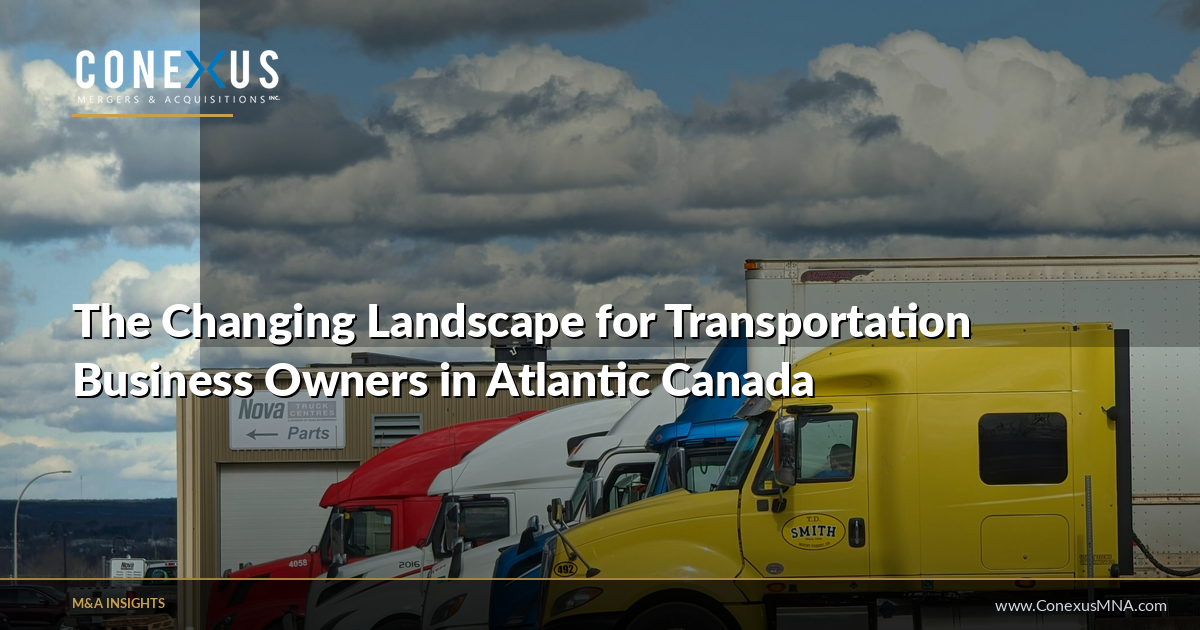
Transportation businesses in Atlantic Canada were built on reliability:
- The routes were established over years
- The customer relationships were earned through decades of on-time delivery, flexible service, and the kind of responsive problem-solving that only comes from an owner who answers the phone personally
- The carrier authority, the fleet, the driver relationships, the safety rating — all of it accumulated slowly, through consistent performance, across thousands of loads and hundreds of thousands of kilometres
That accumulated value is real. It is also, for a growing number of owner-operators approaching the end of their working careers, at risk of being quietly destroyed rather than transferred — not through any dramatic failure, but through the slow deterioration that happens when an aging business without a succession plan begins to drift.
For transportation business owners in Nova Scotia, New Brunswick, Newfoundland and Labrador, and Prince Edward Island, the question is increasingly urgent: what happens to what you've built, and who is going to own it when you're ready to step back?
The Owner-Operator Cohort Is Aging Out
Atlantic Canada's trucking and transportation sector is heavily owner-operated. The businesses that move freight along the Trans-Canada, service the fishery communities along the South Shore, haul building materials across New Brunswick, or connect PEI's agricultural producers to mainland markets are predominantly built around individual owners — often founders who started with one or two trucks and grew through reinvestment, relationship-building, and the operational discipline that running a transportation business demands.
That generation is aging. The average age of transportation business owners in Atlantic Canada tracks closely with the regional demographic — older than the national average, with a significant cohort now in their late fifties and sixties. Many of them are running their operations actively, but the physical demands of the industry, the regulatory compliance burden that has grown substantially over the past decade, and the relentless pressure of fleet management, driver recruitment, and fuel cost volatility are taking a toll that owners don't always acknowledge.
The Canadian Trucking Alliance has documented a driver shortage across the country that is structural rather than cyclical — rooted in an aging driver workforce, barriers to commercial licence acquisition, and a persistent inability to attract younger workers to long-haul driving careers. Atlantic Canada's driver shortage is more acute than in most regions, compounded by the same demographic pressures that affect every sector in the Maritime provinces and Newfoundland.
For transportation owners, the driver shortage cuts in two directions. It makes running the business harder — routes go unserviced, customers experience delays, owner-operators who can't find drivers have to choose between turning away work and running harder themselves. And it makes succession harder, because the experienced drivers and dispatchers who might become the next generation of operational leadership are in short supply and high demand across the sector.
What Happens When Maintenance Starts to Slide
One of the most reliable indicators that a transportation business is approaching an unplanned wind-down is the state of its fleet. Maintenance in a well-run trucking operation is disciplined, systematic, and documented: scheduled preventive maintenance, timely component replacement, clean inspection records, and a fleet that runs with a consistent maintenance profile. It is also expensive — and when an owner approaching retirement begins to prioritize cash extraction over reinvestment, fleet maintenance is often the first casualty.
Buyers of transportation businesses conduct detailed fleet assessments. They look at maintenance records, inspection histories, remaining useful life on major components, and the capital investment required to bring the fleet to a standard that can support continued operations.
| Well-Maintained Fleet | Deferred-Maintenance Fleet |
|---|---|
| Scheduled PMs completed on time and documented | Maintenance intervals extended, records incomplete or missing |
| Buyer confidence that the fleet supports continued operations at current capacity | Buyer deducts the cost of bringing fleet to standard from their offer price — often aggressively |
| Clean safety rating — few or no inspection deficiencies on record | Safety rating with accumulated blemishes — triggers concern about regulatory risk |
| Commands premium valuation; supports financing by buyer's lender | Price reductions in due diligence; lenders may require fleet investment as a condition of financing |
The progressive deterioration pattern is what makes waiting particularly dangerous. A transportation business at peak value — routes established, customers satisfied, fleet in good condition, safety record clean — is worth substantially more than the same business three years later, after maintenance has been deferred, a key customer contract has drifted to a competitor, driver turnover has increased, and the safety rating has accumulated blemishes. The difference in transaction value between those two points can be significant. And the owner who reaches the second point rarely intended to — they simply didn't act at the first.
Established Routes, Contracts, and Carrier Authorities Are the Real Asset
Transportation owners sometimes underestimate the value of what they've built because the most valuable components of their business aren't visible in the way that equipment is visible. The trucks, the trailers, the terminal — these are tangible assets that can be appraised and understood easily. The intangible assets that often represent the majority of enterprise value in a well-run transportation business are harder to see — but they are what sophisticated buyers are really paying for:
- Established routes and load commitments. A carrier that moves freight reliably between specific origin and destination pairs — Sydney and Halifax, Saint John and Moncton, Corner Brook and St. John's — has built a route structure that generates predictable, recurring revenue. That route knowledge — the optimal scheduling, the customer service standards that have earned the volume, the driver familiarity with the route and its requirements — is embedded in the operation and represents genuine competitive value. Buyers who understand transportation M&A know that an established route network is worth more than the trucks that run it.
- Customer contracts and shipper relationships. The fish plant in Yarmouth that calls your dispatcher first, the lumber yard in Bathurst that has been on your billing since 1998, the agricultural cooperative in Summerside that depends on your service for their seasonal volumes — these relationships are the revenue base of the business. Where they are documented in written contracts with renewal provisions, they are visible and transferable. Where they exist only as informal arrangements, they are real but fragile. Formalizing the most significant customer relationships into written agreements before going to market is one of the most direct ways to translate relationship value into transaction value.
- Carrier authority and safety record. A commercial carrier operating authority — federal or provincial, depending on the scope of operations — takes years to establish in good standing. A safety rating that is satisfactory or excellent reflects years of compliance, inspection performance, and driver management discipline. These regulatory assets are not easy to build from scratch, and buyers who need to operate in Atlantic Canada know it. The carrier with a clean regulatory history is acquiring a standing in the market that has real worth.
The Consolidation Dynamic in Atlantic Canadian Transportation
The transportation sector in Atlantic Canada is consolidating. Larger carriers based in Atlantic Canada are acquiring smaller regional operators to expand their geographic coverage, add specialized service capabilities, and absorb route networks that complement their existing operations. National carriers with Atlantic Canadian ambitions are acquiring established regional businesses rather than building from scratch. And private equity has identified logistics and transportation as a sector where fragmentation creates platform-building opportunities.
For the owner of a well-run regional carrier, this consolidation dynamic is directly relevant to the sale process. The right strategic acquirer — a regional carrier whose route network is complementary to yours, a national operator looking to establish an Atlantic Canadian hub, a PE-backed platform actively building in the sector — will pay a different price than a financial buyer who is simply discounting your free cash flow.
Strategic acquirers pay for synergies: the routes that fill gaps in their network, the customer relationships that complement their existing shipper base, the drivers and dispatching capacity they need but can't recruit fast enough. Identifying which buyers are strategically motivated — and running a process that engages them simultaneously and competitively — is the work of an M&A process. It does not happen through informal approaches, through word of mouth, or through the owner calling one or two contacts in the industry. It happens through a structured process run by advisors who know the sector's consolidation dynamics and who can position your business to the buyers most likely to compete seriously for it.
Preparing a Transportation Business for Sale
The preparation that produces the best outcomes in transportation M&A is specific to the sector. Beyond the standard financial preparation that applies to any business sale, transportation businesses benefit from targeted preparation in four specific areas:
- Fleet documentation and maintenance records. A current, organized fleet register — with vehicle identification, purchase date, mileage, maintenance history, inspection records, and remaining useful life estimates for major components — is the foundation of credible asset documentation. Third-party equipment appraisals for significant fleet assets, conducted before going to market, provide a defensible value that buyers can rely on rather than having to establish their own assessment from scratch.
- Safety and compliance record organization. NSC (National Safety Code) compliance records, CVOR history, carrier authority documentation, and driver qualification files should be organized, current, and complete before a buyer's due diligence begins. Compliance gaps discovered in due diligence create negotiating friction, price adjustments, and in the worst cases, transaction failures. Getting ahead of these issues proactively — on your timeline, not a buyer's — is straightforward preparation that pays dividends in a smoother sale process.
- Customer contract formalization. Review the top ten to fifteen customers by revenue. Identify which relationships are documented in written contracts and which are informal. Where significant shipper relationships are informal, engage those customers in written service agreements — even simple ones — that establish the relationship on a documented basis. This is valuation-enhancing work that takes time to do credibly; starting two years before a planned sale is the right timeline.
- Driver and operations team stability. Demonstrate that the business can run without the owner's daily involvement. This means a dispatcher or operations manager who can manage day-to-day logistics, a driver relations function that isn't entirely owner-dependent, and documented operating procedures that a buyer's team can follow. The transportation business where the owner is the de facto dispatcher, recruiter, and account manager for all significant customers faces a steeper preparation challenge — but it's one that can be addressed with lead time.
The Cost of Waiting in a Fleet-Based Business
Transportation businesses depreciate. The trucks lose value every year. The routes that were built on the owner's relationships require active relationship maintenance to stay competitive. The drivers who are loyal to the current owner are making their own career decisions and won't wait indefinitely for ownership clarity. The customer contracts that represent the most valuable revenue streams are up for renewal on schedules that don't align to the owner's internal timeline.
The owner who defers the succession conversation while these dynamics play out is not preserving value. They are allowing it to drift in ways that aren't always visible from the inside. A business that looks similar on the surface — same trucks, same routes, roughly similar revenue — may have materially less value than it did three years earlier because the maintenance has been deferred, the key driver has left, the largest customer has quietly shifted thirty percent of its volume to a competitor, and the owner's physical energy for the business has visibly declined.
A structured valuation — an honest, current assessment of what the business is worth in the market right now — is the starting point for any meaningful succession conversation. It establishes a baseline, identifies the value drivers that need to be protected or strengthened, and gives the owner a realistic picture of what a planned exit could produce compared to the alternatives.
The bottom line: the value in a transportation business is not static. It needs to be captured while it exists — not after it has been quietly eroded by the things that happen when an owner begins to mentally check out before the business is formally sold.
If you own a transportation or trucking business in Atlantic Canada and want a clear-eyed assessment of what it's worth and what a planned transition could look like, we'd welcome a confidential conversation. Contact Conexus M&A — no obligation, no pressure, no commitment.
Just an honest discussion with advisors who understand Atlantic Canadian transportation M&A and can give you the specific answers your situation requires.